Power Bands Wholesale: A B2B Buyer’s Guide to Sourcing Custom Resistance Bands
Power bands have become a core product category for fitness brands, gyms, sporting goods distributors and online sellers.
Unlike small loop bands designed mainly for lower-body exercises and activation workouts, power bands are long continuous-loop resistance bands that can support a wider range of training applications, including strength training, stretching, mobility work and assisted pull-up exercises.
For B2B buyers, however, sourcing power bands is not simply about finding the lowest price.
Material, resistance range, product consistency, branding, packaging and the overall product assortment can significantly affect how successfully the product performs in the target market.
This guide explains the main factors fitness brands, wholesalers, distributors and Amazon sellers should evaluate when sourcing power resistance bands from an OEM supplier.
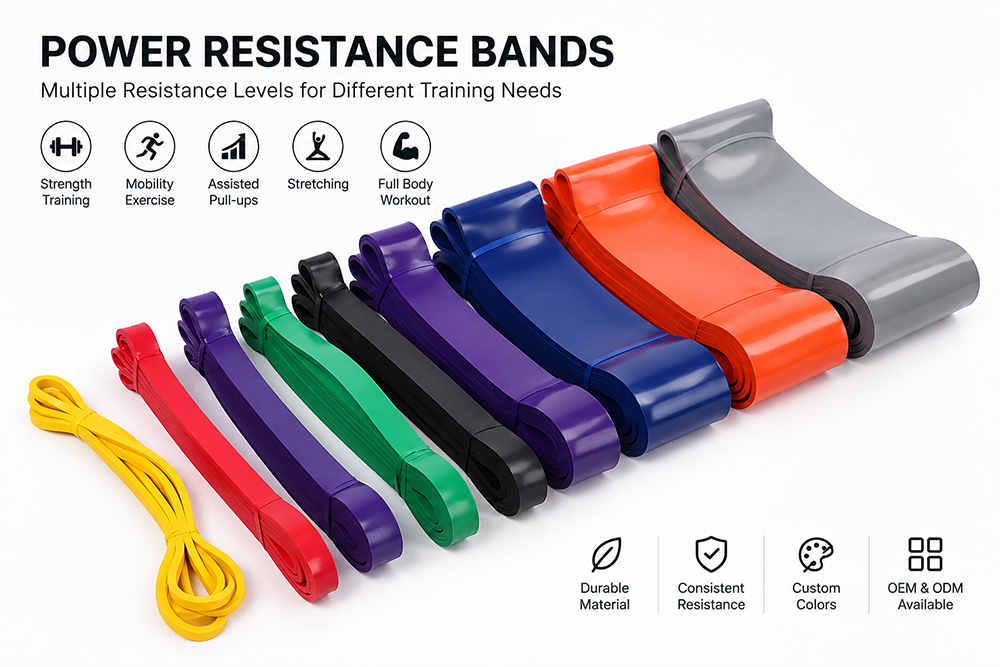
What Are Power Resistance Bands?
Power bands are continuous-loop resistance bands designed for strength, mobility and functional training.
They are commonly sold individually or as multi-resistance sets.
Because one product category can serve beginners, home fitness users, gym members and more experienced athletes, power bands can be a practical addition to a fitness brand’s resistance-training range.
From a B2B sourcing perspective, they are also flexible products because buyers can develop different combinations of:
- resistance levels
- colors
- branding
- packaging
- individual bands
- multi-band sets
The best configuration depends on your target customer and sales channel.
Who Buys Power Bands in Bulk?
Wholesale power bands can serve several different B2B markets.
Fitness Brands
Private-label fitness brands may add power bands as part of a broader resistance-training collection.
For example, a brand can combine power bands with mini loop bands, fabric hip bands or tube resistance bands to create a more complete resistance-training product line.
Wholesalers and Distributors
Distributors generally need products that can serve multiple retailers or customer groups.
For these buyers, having several resistance options and clear product differentiation can make inventory easier to manage.
Amazon and E-Commerce Sellers
Online sellers need to consider more than the band itself.
Packaging size, product presentation, color combinations, instruction materials, barcode labels and product sets can all influence how the final SKU is positioned online.
Gyms and Fitness Studios
Gyms may purchase power bands for functional training areas, assisted pull-up exercises, stretching or group training.
Their purchasing priorities can therefore differ from retail brands.
Understanding your customer before requesting quotations helps prevent unnecessary product development and makes supplier communication much more efficient.
What Should B2B Buyers Check When Sourcing Power Bands?
1. Material
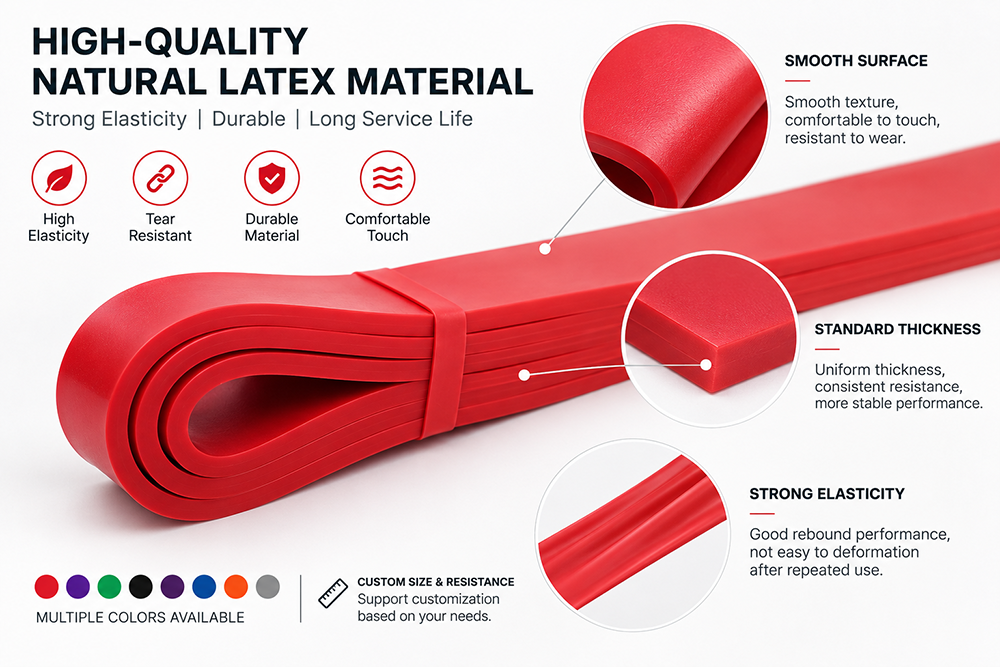
Material is one of the first specifications to confirm with a resistance band supplier.
Resistance bands can be produced using different materials depending on the product type and target market.
Dynamic Fitness currently works with materials including natural latex, TPE and fabric across its resistance-band ranges.
For power bands specifically, buyers should ask the supplier to clearly specify the material offered for the selected model rather than assuming that every resistance band uses the same construction.
When comparing quotations, always compare products with equivalent materials and specifications.
A lower quotation may represent a different product construction rather than simply a lower manufacturing cost.
2. Resistance Range
Power bands are typically offered in multiple resistance options.
For wholesale buyers, the important question is not simply how many levels are available.
The better question is:
Which resistance range makes sense for my target customers?
A general fitness brand may want a range covering several training levels, while a specialist strength-training seller may prefer a different assortment.
Before placing an order, request the resistance specifications for each band you are considering.
For private-label projects, resistance levels may also be customized depending on product requirements and order quantity.
3. Size and Thickness
Dimensions affect both product performance and positioning.
When requesting a quotation, buyers should therefore ask suppliers to clearly identify the dimensions of each proposed model.
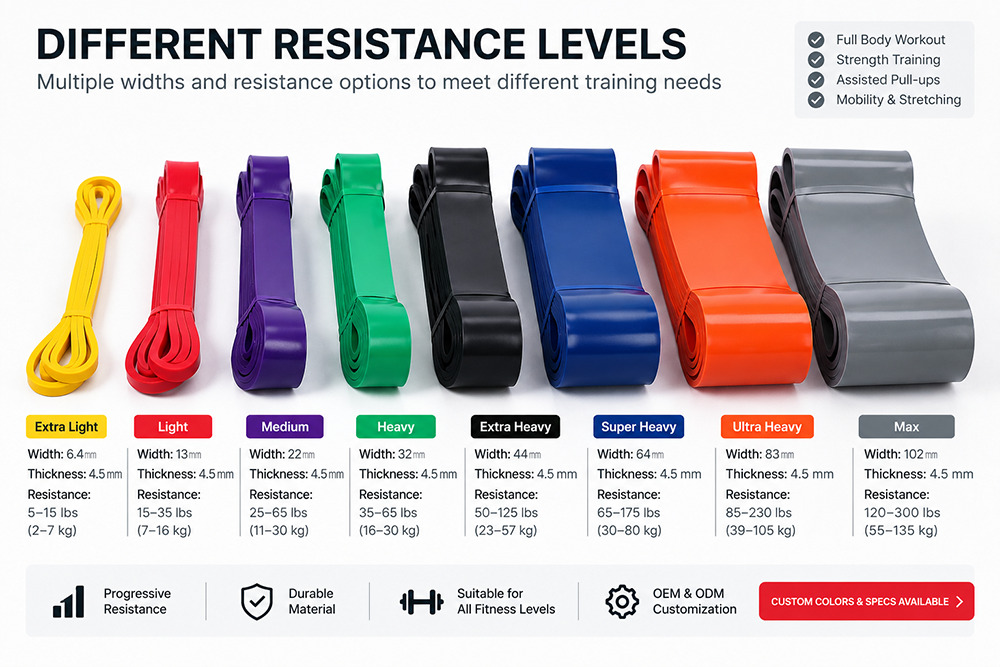
Avoid comparing supplier prices using only terms such as:
“light band”
“medium band”
“heavy band”
Different suppliers may define these terms differently.
A professional RFQ should identify the actual product specifications so that quotations can be compared on the same basis.
Individual Power Bands vs Power Band Sets
Another important purchasing decision is whether to sell bands individually or as a set.
Individual Bands
Selling bands separately allows customers to choose the resistance level they need.
This approach can work well for:
- gyms
- sporting goods stores
- professional training users
- replacement purchases
- distributors carrying a wider SKU range
However, it creates more individual SKUs for the buyer to manage.
Multi-Band Sets
Sets can provide a more complete solution for home fitness and e-commerce customers.
A set may combine several resistance levels and can also include branded packaging or storage accessories depending on the project.
For Amazon sellers and DTC fitness brands, sets may also create a clearer standalone product offer.
There is no universal best option.
The decision should be based on your sales channel, target retail price and customer profile.
Custom Power Bands for Private Label Brands
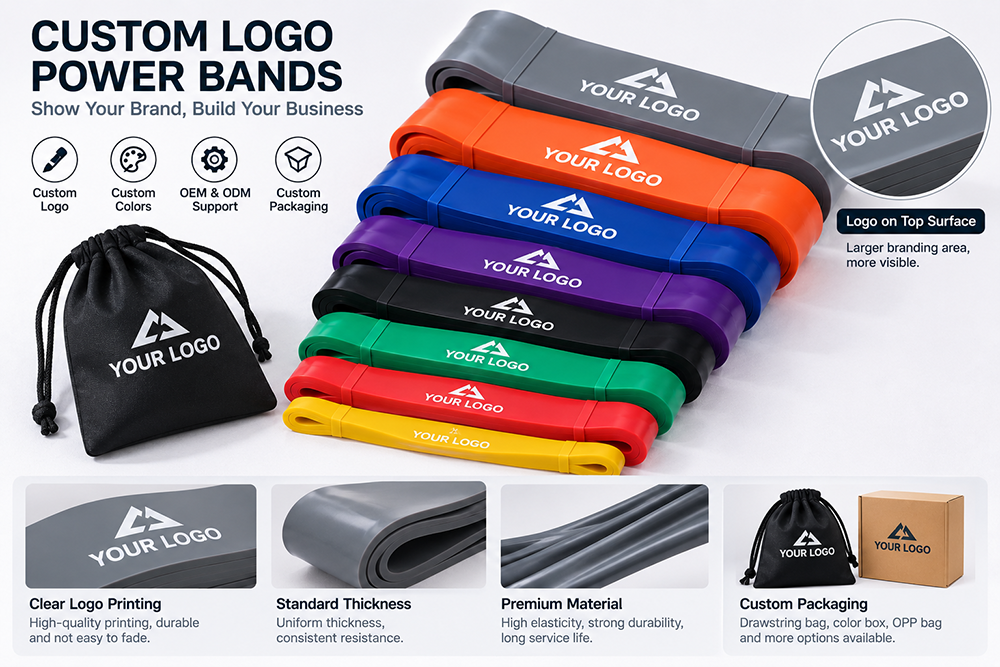
OEM customization can turn a standard resistance band into a product that fits a specific brand identity.
When discussing custom power bands with a manufacturer, consider four main areas.
Custom Colors
Color is often used to differentiate resistance levels and create a recognizable product collection.
Dynamic Fitness supports Pantone color matching for bulk customization.
When developing a color system, think beyond individual products.
If your brand also sells loop bands, fabric bands or yoga accessories, using a consistent color direction across categories can help create a more cohesive collection.
Custom Logo
Logo application should be confirmed during product development.
Available branding methods can depend on the product and material, so buyers should send the supplier their logo artwork and request a recommended solution for the selected model.
Always review a sample or artwork confirmation before mass production.
Custom Packaging
Packaging requirements vary significantly between distribution channels.
Possible packaging solutions available through Dynamic Fitness include options such as carrying bags, OPP bags, retail boxes, barcode labels and instruction cards.
The right option depends on where the product will be sold.
For example, an Amazon seller may prioritize compact shipping dimensions and barcode requirements, while a retail distributor may place greater emphasis on shelf presentation.
Custom Resistance Levels
Resistance specifications may also be customized for OEM projects.
This can be useful when developing a differentiated private-label product rather than purchasing an existing standard assortment.
However, buyers should discuss feasibility and MOQ with the supplier before finalizing the product range.
What Information Should You Send When Requesting a Power Band Quote?
One of the easiest ways to speed up sourcing is to send a complete RFQ.
Instead of writing:
“Please send me your best price for power bands.”
provide as much purchasing information as possible.
A useful RFQ should include:
- target market
- estimated quantity
- required resistance levels
- preferred colors
- logo requirements
- packaging requirements
- individual bands or sets
- destination country
- expected sales channel
- reference photos if you are matching an existing product
If some specifications are not decided yet, tell the supplier.
A good supplier should then be able to recommend suitable options based on your target market and expected quantity.
Questions to Ask a Power Band Manufacturer Before Ordering
Before confirming a bulk order, B2B buyers should clarify several practical questions.
What Is the MOQ?
MOQ can vary depending on the product, color, logo and packaging requirements.
Instead of asking only for the general MOQ, request separate information for:
- standard product
- custom logo
- custom color
- custom packaging
This helps you understand which customization option is driving the minimum order quantity.
Can I Order Samples?
Samples are particularly important for resistance products.
They allow buyers to evaluate the product construction, elasticity, appearance, branding and packaging before committing to mass production.
Dynamic Fitness supports sample orders before mass production.
What Quality Checks Are Performed?
Ask how the supplier checks:
- materials
- dimensions
- resistance
- elasticity
- logo appearance
- packaging
- quantities before shipment
Dynamic Fitness states that its production process includes incoming, in-process, final and outgoing quality-control stages.
For a specific project, buyers should still confirm which inspection points apply to the exact product being ordered.
What Is the Production Lead Time?
Lead time depends on factors such as quantity and customization requirements.
Always confirm production timing based on your actual order rather than relying on a general estimate.
For seasonal promotions or product launches, allow additional time for sampling, artwork approval and packaging confirmation before mass production begins.
Power Bands vs Other Resistance Bands: Which Should You Source?
Power bands do not need to be your only resistance product.
Different resistance-band categories address different training needs.
Power Bands
Suitable for strength training, mobility exercises, stretching and assisted pull-up training.
Loop Resistance Bands
Compact loop bands are commonly used for activation exercises, lower-body workouts and portable home training.
They can work well as entry-level resistance products or multi-band sets.
Tube Resistance Bands
Tube bands can be paired with handles and accessories, making them suitable for home workout systems and resistance-training kits.
Fabric Resistance Bands
Fabric bands are often positioned around lower-body and glute training and can provide a different feel from latex-style bands.
For brands building a complete resistance-training collection, these categories can complement rather than replace each other.
How to Build a Better Resistance Band Product Line
A common sourcing mistake is selecting products individually without considering how they work together as a collection.
A more strategic approach is to build a resistance-training range around different customer needs.
For example, a brand might develop:
Entry-Level Home Fitness
Mini loop resistance bands and basic fitness accessories.
Strength & Functional Training
Power bands in several resistance options.
Home Workout Sets
Tube resistance bands with handles and accessories.
Glute & Lower-Body Training
Fabric resistance bands or hip bands.
This approach allows buyers to create multiple product categories while maintaining a consistent brand identity.
It can also simplify future product expansion.
OEM Power Band Sourcing Checklist
Before confirming your power band order, check the following:
- product material confirmed
- dimensions confirmed
- resistance specifications confirmed
- color requirements confirmed
- logo artwork approved
- packaging format confirmed
- barcode or labeling requirements confirmed
- sample approved
- order quantity confirmed
- production lead time confirmed
- carton information confirmed
- shipping destination confirmed
Having these details documented before mass production reduces misunderstandings between buyer and supplier.
Final Thoughts
Finding a power bands wholesale supplier is relatively easy.
Building the right product for your market requires more consideration.
For B2B buyers, the key is to evaluate the entire product—not only unit price.
Material, resistance assortment, branding, packaging, quality control and sales-channel requirements should all be discussed before placing a bulk order.
For fitness brands and distributors planning a wider resistance-training collection, it can also be more efficient to source complementary products such as loop resistance bands, tube resistance bands and fabric resistance bands together.
Looking for Custom Power Bands for Your Brand?
Dynamic Fitness provides OEM and ODM support for resistance bands and related fitness accessories, including custom logo, colors, packaging, sizes and resistance options.
If you are developing a new power band product or expanding an existing resistance-training collection, send us your target product, estimated quantity, target market, logo and packaging requirements.
We can review your requirements and recommend suitable product and customization options for your project.