No fitness equipment manufacturer in China makes everything well. A plant that welds commercial cable machines has little in common with one that dips latex resistance bands or cuts yoga mats. So the useful question is not “who is the best manufacturer?” but “which type of manufacturer makes my product, and can it prove it?”
Start from your product list. Match each product family to a manufacturer type and a region, then ask each candidate for evidence tied to the exact item you want to buy. The main exception is a full gym fit-out: it mixes machines, free weights and accessories, so you will end up with several specialists or one coordinator managing them.
When we checked Google’s results for this search in November 2026, most “top manufacturer” lists were published by manufacturers or directories. They are useful for collecting names. They cannot tell you whether a factory fits your product, your market or your order size.
Four types of fitness manufacturers, and what each can do for you
Chinese fitness manufacturers specialize by process, not by the word “fitness”. Sort your product list into the four families below before you contact anyone, and send each family to suppliers that actually run those processes.
| Product family | Typical processes | What decides quality | What drives MOQ and order size |
|---|---|---|---|
| Commercial strength machines, racks, benches | Steel tube cutting, welding, powder coating, upholstery, cable and pulley assembly | Steel gauge, weld quality, bearings, pulleys, cables, weight-stack accuracy | Model and finish; freight per unit drops when you fill a container |
| Cardio equipment (treadmills, bikes, rowers) | Motors and drives, electronics, consoles, final assembly | Drive system, electrical safety, spare parts and service in your market | Model, voltage and plug type, console language |
| Free weights (dumbbells, kettlebells, plates) | Casting or machining, coating, weighing | Weight tolerance, coating durability, handle finish, packing strength | Weight range, coating and color, freight cost per kilogram |
| Accessories (resistance bands, yoga mats, foam rollers, balls) | Latex dipping or extrusion, foaming and cutting, molding, sewing, printing, packing | Material formulation, thickness and dimensions, resistance consistency, odor | Color batches, logo print setup, custom packaging runs |
The families also fail in different ways. In gym-owner communities on Reddit, the worst stories are about machines with moving parts: bearings, pulleys and cables that wore out within a year under commercial use. Other buyers report that plates, bars and flooring held up well, sometimes from the same supplier.
Two lessons follow. First, ask for component specifications (bearing type, pulley material, cable rating, steel gauge) rather than judging a machine by photos, because buyers say they cannot tell a commercial-duty series from a light-commercial one in a catalog. Second, plan spare parts and service for anything electrical. One gym fitter who toured factories for days wrote that they now buy cardio only where local parts and service exist.
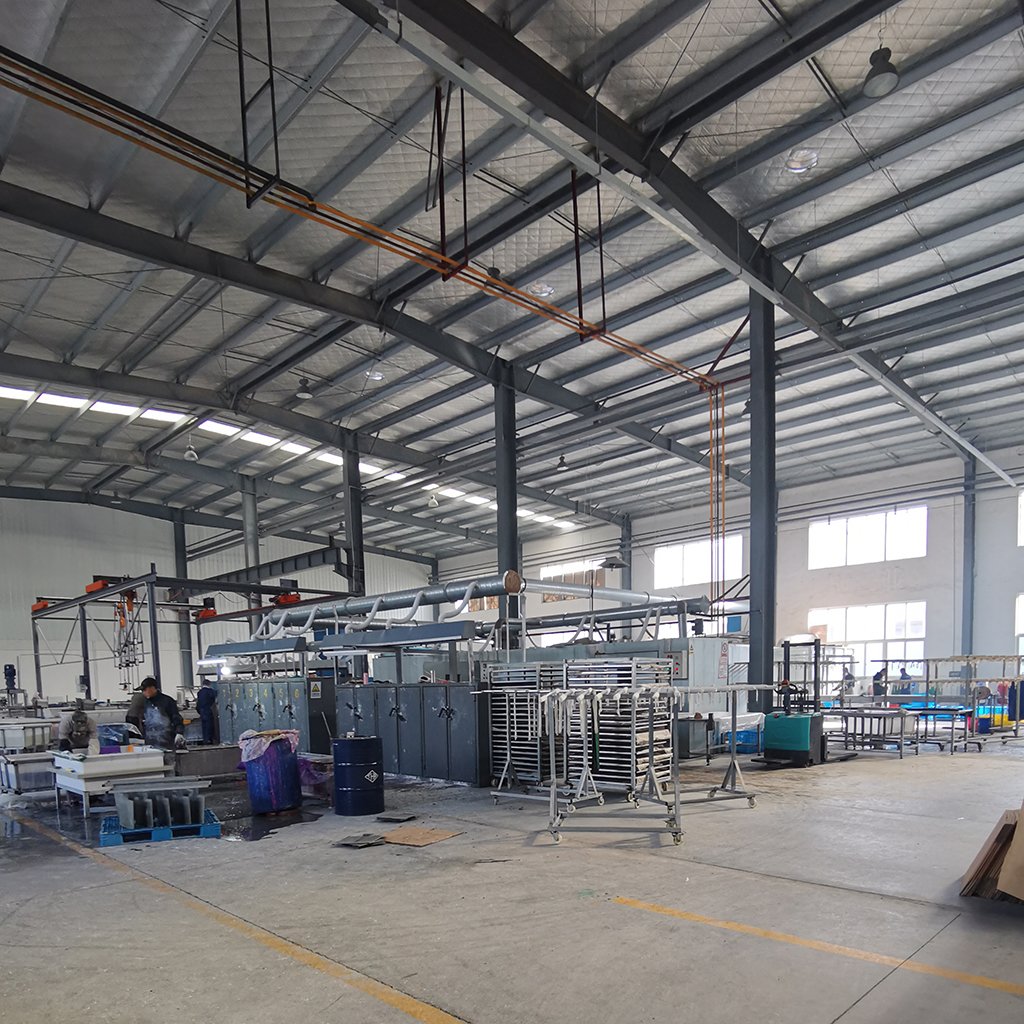
Where each type is concentrated: China’s fitness manufacturing clusters
Clusters help you find candidates and plan a visit that covers several factories in one trip. They do not qualify any single factory, and quality inside a cluster varies widely. The overview below summarizes the hubs described by IWF Shanghai’s review of China’s fitness industry, a fitness trade fair organizer.
| Cluster | Main cities named | Categories associated with it |
|---|---|---|
| Shandong | Dezhou, Ningjin, Qingdao, Rizhao, Zibo | Commercial fitness equipment |
| Fujian | Xiamen | Fitness equipment and massage devices, export oriented |
| Jiangsu | Nantong | Functional training equipment, dumbbells, barbells, kettlebells, yoga supplies |
| Zhejiang | Yiwu, Yongkang, Wuyi | Home fitness equipment and e-commerce supply chains |
| Hebei | Dingzhou | Iron gym equipment, including dumbbells and barbells |
| Guangdong | Guangzhou, Shenzhen | Smart and connected fitness equipment, sporting goods companies |
Use the table to decide where to search first, then judge each factory on its own evidence. Small accessories are made in many regions, so for bands, mats and rollers the process and material matter more than the address.
What OEM, ODM, MOQ and samples mean for each type
OEM means the factory builds to your design or specification; ODM means you pick one of its existing designs and sell it under your brand. With most machine makers, what buyers call OEM is closer to ODM: your colors, upholstery and logo on their existing frames. A real redesign, such as a different stack weight or frame height, costs more and takes longer, and some suppliers who advertise “full customization” turn out to sell only their catalog.
For accessories, customization goes deeper into the product itself: material, color, resistance level, thickness, print and packaging. Minimum order quantities usually attach to setups rather than to the product. A custom Pantone color needs its own material batch, a printed logo needs a print setup, and a printed box needs its own run. That is why a supplier can sell a stock band in small quantities but ask for more once your logo goes on the band itself.
Samples follow the same split. An accessory sample can often be made quickly; at our resistance band facility, standard samples are often ready within 3–5 working days, depending on customization. A machine sample is usually a full unit shipped by sea, or a visit to the showroom, so some buyers order a single machine before committing to a full line.
Whatever the type, ask for the MOQ by SKU, by color, by logo method and by packaging version. One headline number hides which of those setups it covers.
The evidence to request before a manufacturer makes your shortlist
A shortlist should be built on evidence for your exact item, not on the size of a catalog. Send every candidate the same request and compare the answers side by side.
| What to request | How to check it | Red flag |
|---|---|---|
| Model number or specification sheet for your item | Match it to photos, the sample and any test report | Catalog images that cannot be tied to a model or spec |
| Which steps are done in-house and which are outsourced | Ask them to walk you through the process for your product | “We make everything” with no detail on how |
| Live video of the process for your product, during working hours | Look for your product or its material on the line, not a showroom | Only edited promotional footage |
| Component or material specification (steel gauge, bearings, latex type, mat material) | Compare with the quote and later with the sample | Vague terms such as “premium” or “eco” with no definition |
| MOQ by SKU, color, logo and packaging | Get each figure in writing | One MOQ with no explanation of what it covers |
| Test reports for the product and your market | Check issuer, model, material and date | A certificate logo or a report for a different model |
| Spare parts list and warranty terms (machines) | Read what is covered, for how long, and who ships parts | Verbal guarantees only |
Buyers also judge manufacturers by how they talk. One home-gym importer contacted about 20 rack suppliers and found that some reps clearly knew their product while others were reselling someone else’s racks. Specific answers to specific questions are a better signal than fast, agreeable ones.
For the full legal and payment checks on one supplier, follow our guide on how to verify a Chinese fitness factory before you pay a deposit.
Compliance: match the document to the product and the market
No single “fitness equipment certificate” covers every product and market. The right evidence depends on what the product is, who uses it and where it is sold.
- Stationary training equipment. ISO 20957-1 sets general safety requirements and test methods for stationary training equipment, and further parts cover specific types, such as ISO 20957-2 for strength training equipment. These standards do not cover resistance bands or yoga mats.
- United States. ASTM F2276 is a specification for fitness equipment. Check whether it applies to your exact product rather than treating it as a universal certificate.
- Rubber and plastic accessories sold in the EU. REACH restricts certain substances in articles. For example, Annex XVII entry 50 limits PAHs in rubber or plastic parts that touch the skin; see ECHA’s list of restricted substances. Ask for a test report on your actual material and color.
- EU consumer products in general. The General Product Safety Regulation (EU) 2023/988 applies alongside product-specific rules.
- California. Under Proposition 65, businesses in the supply chain must decide whether a warning is needed, based on exposure to listed chemicals. A supplier cannot settle that for you with one generic document.
- CE marking. CE marking applies only to products covered by EU legislation that requires it. A “CE certificate” for a yoga mat or a resistance band usually tells you little.
Ask a compliance advisor or an accredited lab which requirements apply before you ask suppliers for documents. Then request reports that name your product, material and market.
Build a shortlist you can defend
A good shortlist is short: three to five manufacturers per product family, each with comparable evidence. Score them on the criteria below and keep unknowns visible instead of hiding them in a total.
- Category fit: does the manufacturer run the processes your product needs?
- Evidence for your item: model, materials, process and test documents that match.
- Customization fit: can it make your changes, and at what MOQ for each setup?
- Sample quality: does the sample match your specification, measured, not eyeballed?
- Communication: precise answers, clear limits, and someone who can answer technical questions.
- After-sales: spare parts, warranty wording and how defects are handled, especially for machines.
A low price should never offset a zero on evidence or after-sales. If a supplier cannot identify the material in its test report or will not put warranty terms in writing, mark it unverified and move on.
To see machines before you buy, trade fairs help. The China Sport Show, IWF Shanghai, FIBO in Cologne and the Canton Fair all bring fitness suppliers together. Treat a booth as a lead, not proof that the exhibitor makes the product.
Frequently asked questions
Are Chinese fitness equipment manufacturers reliable?
Some are excellent and some are not, and the gap is wide. Reliability shows up in evidence for your exact product: the process, materials, test reports, a sample that matches your specification and warranty terms in writing. Judge each factory and each model on its own, not the country or the cluster.
What is a typical MOQ for fitness equipment from China?
There is no typical figure across categories. For machines, the practical minimum is often what fills a container economically. For accessories, color batches, logo print setups and packaging runs set the minimum, so ask for it by SKU, color, logo method and packaging version.
Can a small brand get private label fitness products made in China?
Yes. Many accessory manufacturers start small brands on a stock product with the logo on the packaging. Custom colors and printing on the product itself usually need larger quantities, so add them once a product sells.
Should I visit the factory before ordering?
For machines, large custom orders or a first order with a new supplier, a visit or an independent audit is worth the cost. For smaller accessory orders, a live video walk-through in working hours, checked documents and a pre-shipment inspection often give enough evidence.
Where Dynamic Fitness Life fits
We are a resistance band manufacturer with a 4,000 m² production area. Loop, power, tube, flat and fabric bands are made in our own facility, from material preparation and latex dipping to cutting, logo printing, tensile testing and packing. You can see the options on our private label resistance bands page.
For related accessories, such as yoga and Pilates products, foam rollers, massage balls and small strength items, we work with partner factories and coordinate samples, inspections and shipping. If your list mixes several categories, read our guide to choosing a fitness products supplier for a mixed range. For commercial machines and cardio equipment, use a specialist machine manufacturer and the evidence list above.
Next step: send us your product list with target quantities, materials and the market you sell in. We will tell you which items we make ourselves, which we would source through partners, and what evidence we can show for each. Contact our team.